
History
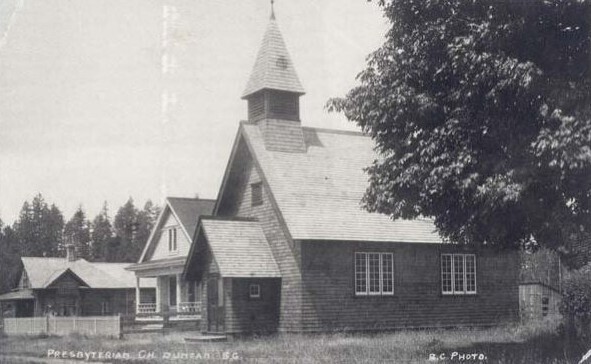
St. Andrew's began in 1902. In 1907 the original church was built on First Street in downtown Duncan, BC, and in 1960 the church relocated up “old hospital hill” to the current sanctuary on Herbert Street. The small building was increased in size a decade later, and the congregation has since converted the former onsite manse to accommodate a community preschool as well as provide additional office and classroom space. Today the church grounds also include a community garden and a columbarium.
“The Church on the Hill” is a history written and curated by Chuck Kinney. It presents a detailed, 100-year history of St Andrew’s Presbyterian Church in Duncan, British Columbia, tracing its origins, struggles, growth, and enduring faith community. This is summary of that document.
Founding and Early Years (1902–1907)
The church began with missionary Rev. W.N. Carr, who first served in Crofton and soon extended his ministry to Duncan and Chemainus around 1902–1903
Services were initially held in the local Methodist church until the first Presbyterian building was constructed in 1907, designed and supervised by Rev. WJE Robertson and dedicated on September 7, 1907
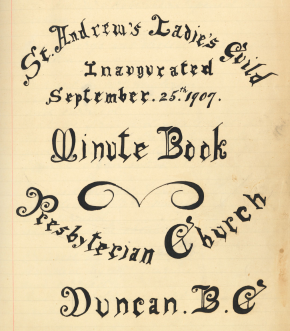
A Ladies Guild formed soon after and became a major force of support for the church’s ministries for over 90 years.
Church Union Crisis (1924–1926)
The proposed 1925 Church Union (forming the United Church of Canada) deeply divided the congregation. A majority voted to join the Union, but a significant minority (24 members) chose to remain Presbyterian and fought to retain the church property. Eventually, the Commission awarded the original church building back to the “continuing Presbyterians” for a payment of $250.
Hard Times and Rebuilding (1926–1940s)
Post-Union, the Presbyterian congregation was drastically reduced and often without a minister. Students and temporary clergy served until stability gradually returned. Despite financial hardship and limited resources, the congregation persisted, demonstrating significant resilience and faithfulness.
By the 1940s, under ministers like Rev. RS Stevens, morale and membership improved. The 40th anniversary of the church building was celebrated in 1947, marking renewed growth and community engagement.
Mid-Century Transitions (1950s–1970s)
Throughout the mid-20th century, the church faced recurring financial challenges, turnover in ministers, and occasional internal tensions. Reports show ongoing struggles with budgets, attendance, and ministerial stability.
In the early 1970s, the church attempted several fresh starts with newly graduated ministers, including Rev. Fred Reed in 1972 and Rev. James Statham in 1973. Statham’s ministry began a period of renewed energy and reorganization, including bringing in experienced elders and forming a stronger Session foundation.
Growth and Renewal (1980s–1990s)
In the late 1990s the church undertook strategic planning, staffing discussions, financial restructuring, and upgrades to worship life (music ministry, sound system), while coping with deficits and losses of key members.
Into the New Century (2000–2007)
Entering the 2000s, St. Andrew’s continued to develop ministry programs, expanding study groups, strengthening missions, and seeking to serve the Cowichan Valley community.
Conclusion
The history written by Chuck Kinney closes by emphasizing:
The consistent faithfulness of God.
The importance of prayer.
The resilience of the congregation despite repeated hardships.
As summarized by Rev. Kerry McIntyre, the church’s story is one of God “shepherding His people” across generations, giving confidence for the future.